Mark Webster’s April Message and Programme are here. Please check whether you need to book a place on the mini-bus when making your plans.
Yare Valley Meadow Makers rake it in
A message from Matt Tomlinson received today:
“We will meet at the UEA meadow at 10am this Sunday to rake up the arisings from the meadow after having a spring cut.
It should be a lovely sunny morning, any help is much appreciated.”
Please help if you can. More details here.
Marston Marshes Ornithological Update
Walkers in the Yare Valley have experienced inconvenience with the present extended period of flooding there has been in the valley, but this is nothing compared with the devasting effect it can have on the valley ecosystem. The wildlife of the valley has experienced repeated flooding in the past, and so can be expected to have a degree of resilience in flood conditions, but the recent flooding has continued for an unusually long time. Flooding impacts on both flora and fauna, destroying habitats, drowning wildlife, and spreading disease. It also changes the balance of species to be seen in the valley.

Tim Hill has been out and about on Marston Marsh, and reports on some of the ornithological changes:
“Much of the marsh has been under water for longer than is usual resulting in some new, or rare, wildfowl sightings and some common water birds appearing in larger numbers. In the middle of February black-headed gulls reached a peak number of about 50 along the western half of the river. In amongst them were 3 or 4 common gulls, several herring gulls and the first of the lesser black-backed gulls to arrive. The number of greylag geese gradually increased through February reaching 43 on the 28th of the month. The number has since decreased to single figures since then. This larger number also attracted a couple of Canada geese, a rare sight here. There have been up to three Egyptian geese, with a lone goose staying very close to the boardwalk most of the time. Opposite the seat by the river, at the western end, two oystercatchers have been a regular feature since 17th of February into March. In the same area teal and gadwall have also been seen. On 18th of February there was a single wigeon, on the flood, north of the rail crossing onto the south side of the river. This is the first I have seen here. On the 21st of February there were 3 tufted ducks, on the flooded area, to the south of the stile along Marston Lane. This is also a new species for my marsh list. Three gadwall appeared there a few days later. Little grebes have been heard calling, regularly throughout February, from the flooded areas north of the river and close to the lane. The number of little egrets has peaked at 5.

Bullfinches have returned to the blackthorn bushes to the west of the stile and a stonechat has reappeared to the west of the outflow by the swings. There has been a vocal water rail in the ditch alongside Marston Lane, about halfway between the entrance to the marsh from Abinger Way and the stile. Stock doves have been regularly seen on or around the owl box but may be competing with grey squirrels for its occupancy. At the beginning of March there were about 50 siskins in the trees around the bridge at the east end. Redwings have been around in small numbers, but I have not seen a fieldfare here this year.”
McCarthy Stone Green Space
The new residents currently moving in to properties of the McCarthy Stone phase 2 development on Bluebell Road could expect to have the benefit of a landscaped Green Open Space along the whole length of the southwest edge of the McCarthy Stone site. The Green Open Space would have included meadowland, a pond, and groups of planted parkland trees. Paths would have passed through the green space to link the new estate with the Strawberry Field and to the paths down to the river and the Yare Valley Walk. The plans are here.


The creation of this landscaped Green Open Space is important. UK biodiversity is in serious decline and the green space is intended to compensate, in part, for the biodiversity loss resulting from the built part of the development. It is also important to meet the needs of a growing number of residents in close proximity to the Yare Valley. Pressure of use on the existing green space threatens to be unsustainable. Any additional green open space in the Yare Valley would help ease the pressure of public use on other parts of the Valley.


The Yare Valley Society submitted a detailed report with photographs to Norwich Planning Authority on the present situation.
The Authority acted swiftly. It contacted the developers and a timescale has emerged for when the work can be expected to be done. It reports:
“[The contractors] have been trying to complete the footpath works along the river … though this has been held up by flooding and that they are also needing to undo damage caused by the flooding. They plan to move onto the Open Space land … once the riverbank works are done though they may start sooner if those works can’t as yet be completed. They think they have 5 days work left on the riverbank and that the Open Space works will take about 2 to 3 weeks. They are hoping the Open Space works should be complete by the end of March.”
The Society will closely monitor progress, both on the landscaping, and also on other environmental benefits that were promised when the development was approved.
Action on Path Blockages

Fallen trees have blocked two of the paths from Bluebell Road to the riverside path. One path is via the Strawberry Field and the other alongside the Cringleford Flyover embankment. YVS enquired with the Norwich Fringe as to the landowners who might be responsible for clearing the blockages. Following the enquiry, the NFP contacted the landowner directly, and the landowner has undertaken to clear the blockage on the path from the Strawberry Field to the river.

It is possible to find a way round the Strawberry Field path, but the other path is blocked for all but the most intrepid. The situation is a little less straightforward for this path because the blocking tree has fallen from the highway’s embankment, and so the Norfolk County Council’s Highways Authority is responsible for clearing it. The landowner is reporting the blockage to the Authority. Hopefully the Authority will also reinstate the fence.
Warblers on Marston Marsh 2023
For a number of years, Tim Hill has recorded what he has seen and heard on Marston Marsh. As we enter the new season, Tim looks back on 2023 to inspire us to get out and about to see and hear for ourselves in 2024:
“Chiffchaffs are always the first to arrive. Last year I heard my first on 20th of March and they were singing, or calling, regularly until the middle of October. There was a lone one calling on 25th November about 6 weeks after the last October one.
Blackcaps started singing on 3rd April and stayed until 18th July. A passing bird was heard on 4 September. They do not seem to overwinter here.

Sedge warblers arrived on 16th of April staying until 18th July with a lone one on 1st August.
Whitethroats arrived on 22nd April, and two grasshopper warblers were heard from 24th April. Whitethroats stayed until 1 August and grasshopper warblers until mid-July with a passing one reeling on 10 August, stopping off on its way south.
Reed warblers were heard from 1st May until 24th July. This was another species heard again after a gap of several weeks with one calling on 3rd September.
The warbler that was only heard once was a willow warbler on 26th April. Many years ago, these were regularly heard in the trees around the entrance to the marsh near Abinger Way. Last year saw the reappearance of Cetti’s warblers of which there were probably two. One was heard at the end of March, and early April, and then two territories were identified with birds calling from 9th September to the end of the year.
Blackcaps tend to be found along the path that runs parallel to the old road, from the style to the main entrance. They can also be found in the woods around the seat by the gate at the Western end of the marsh. Garden warblers, which sound similar, tend to prefer the woods by the river but sometimes are seen above the pair of gates leading onto the marsh after entering from Abinger Way. It takes me a while to get tuned in to the difference between their songs each year and often, when I think I have found one of them it shows itself and is the other. After several weeks my recognition improves greatly.
The sedge warblers prefer the strip of reed running north from the bridge at the east end. As more arrive they start to set up territories along the railway embankment at the west end of the marsh too.

Reed warblers seem to like the same strip of reed as the sedge warblers, and again I have to tune in to the year’s particular birds. Reed warblers also like the reeds either side of the path where the blackcaps are found but stay closer to the gate by the style.
Chiffchaffs and whitethroats can be seen, and heard, in any of the wooded areas around the fringes of the site and are probably the most numerous of the warblers. I would estimate that there may be up to ten chiffchaff territories here and possibly as many whitethroat ones.
Grasshopper warblers prefer the central area of the marsh. They are often heard south of the bank that runs from East to West by the owl box or between the river and the golf tee that is cut back into the woods. I have only had one good sighting in previous years, but I have spoken to people who have seen them more recently and more regularly. Two seems to be the normal population.
Goldcrests are here year-round and prefer conifers or ivy covered trees. They are best detected by their reeling song or high-pitched call and can take some time to get a good view of.”
Good news for 2024 is that by the 23rd of January Tim had seen 51 species on Marston Marsh which equals the total for all of January 2023. (Update on 2nd February: Total for all of January 2024 turned out to be 54, a red kite was in the last three of the month).
The Chalk Streams of Norwich and a Great Big March
Norwich has two “chalk streams” the rivers Yare and Wensum. Chalk streams and their associated ecology are very rare globally. In spite of some statutory environmental protections being in place, not infrequently there is a need for groups drawn from the general public to support and reinforce these protections.
For both rivers there is the Norfolk Rivers Trust. Its mission is to restore, protect and enhance the water environments of Norfolk for people and wildlife.
The Yare has the Yare Valley Society. It seeks to promote the enhancement of the river valley for wildlife and informal recreation from Bawburgh to Whitlingham Country Park.
The Wensum too has people who are prepared to act to avoid damage to its ecology. The Norfolk Wildlife Trust, supported by Aviv in a public appeal for funds, raised money to enable them to purchase the Sweet Briar Marshes beside the Wensum in Norwich. The Trust is in process of seeing through a plan to improve the marshes’ ecology and also to provide some public access.
More recently the single-issue group “Stop the Wensum Link” has drawn attention to the threat the proposed Norwich Western Link presents to the ecology of the Wensum. The latest stage of their campaign is a “Great Big March”:

It is encouraging for all who care for the environment that so many ordinary people, and some extraordinary people, are now backing groups that are attempting to reverse, or at least to halt, the present decline in the ecology of the UK.
Coping with Climate Change: mitigation and resilience
In recent days the Yare Valley has again been fulfilling two of its major roles in combating climate change: mitigating its effects and providing resilience. Its marshes, commons and meadows have become storage basins for many cubic metres of flood water slowing down its rush to the sea and lessening the chance of inundation of properties downstream.

We have been deprived of some of our favourite walks, but it is a small price to pay. As compensation there are dramatic views to enjoy. Other obstructions to paths have been fallen trees after storm Henk, but normally a way can be found round or over these.


The depth water on the bridleway was over welly height and rising!
The attenuation basins constructed under the supervision of the Norfolk Rivers Trust below the Strawberry Field have been inundated. As the waters recede the basins will retain water to increase the resilience of the marsh in times of drought and so help safeguard the habitats of water voles and other wildlife.

Meadows’ Friends adopt new name and logo
The Friends of Strawberry Field and UEA meadows have changed their name to “The Yare Valley Meadow Makers” to better describe and emphasize their practical “in field” activities. They also have a new logo:
YVS members will recall that Matt Tomlinson gave a very well received talk about his vision for the meadows at the 2021 AGM. He founded the Friends group three years ago. The group has worked with the landowner of the Strawberry Field to make changes to the management of the field so as to better achieve the group’s long term aim of creating a rich community wildflower meadow. Spurred on by successes in the Strawberry Field the group also became involved in assisting with the nearby hay meadow at UEA. The most recent activity was to scatter yellow rattle seed at the UEA meadow. Yellow rattle is a well-known meadow maker.

Making wetlands more resilient to climate change
Norfolk Rivers Trust have been overseeing work on the wetlands between the Strawberry Field and the river. The aim is to make the wetlands more resilient to climate change. Recent extended droughts have resulted in some of the wetland peat drying out, with release of carbon dioxide, and an adverse effect on flora and fauna. Pools are being created to store more water in time of flood, the water then being available during dry periods.
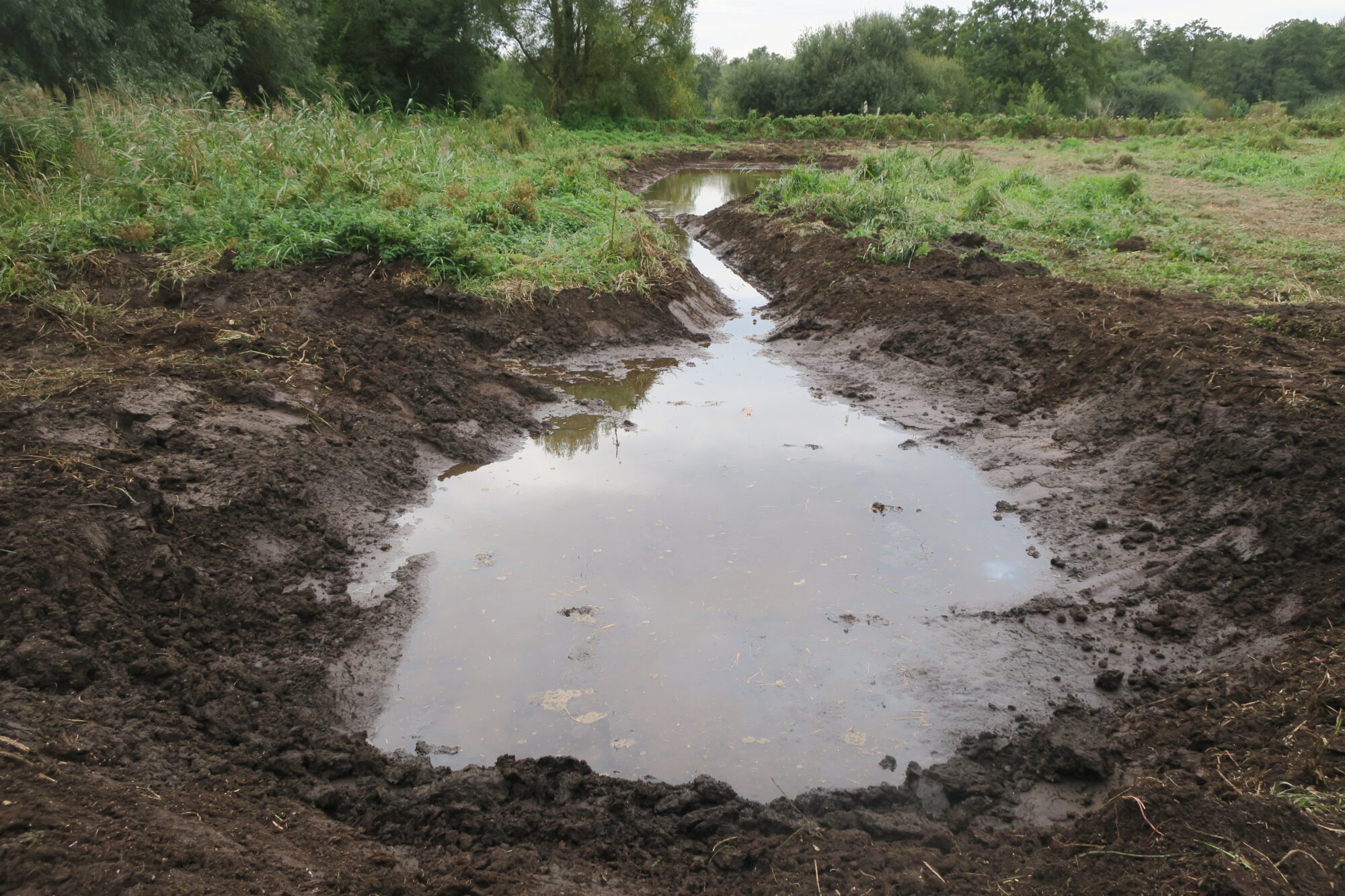
In the foreground is a stilling pool. This is deep enough to reduce the velocity or turbulence of the water flowing into the pool system and encourage sedimentation prior to the water entering the main pool. The channel leads to the main water storage pool.
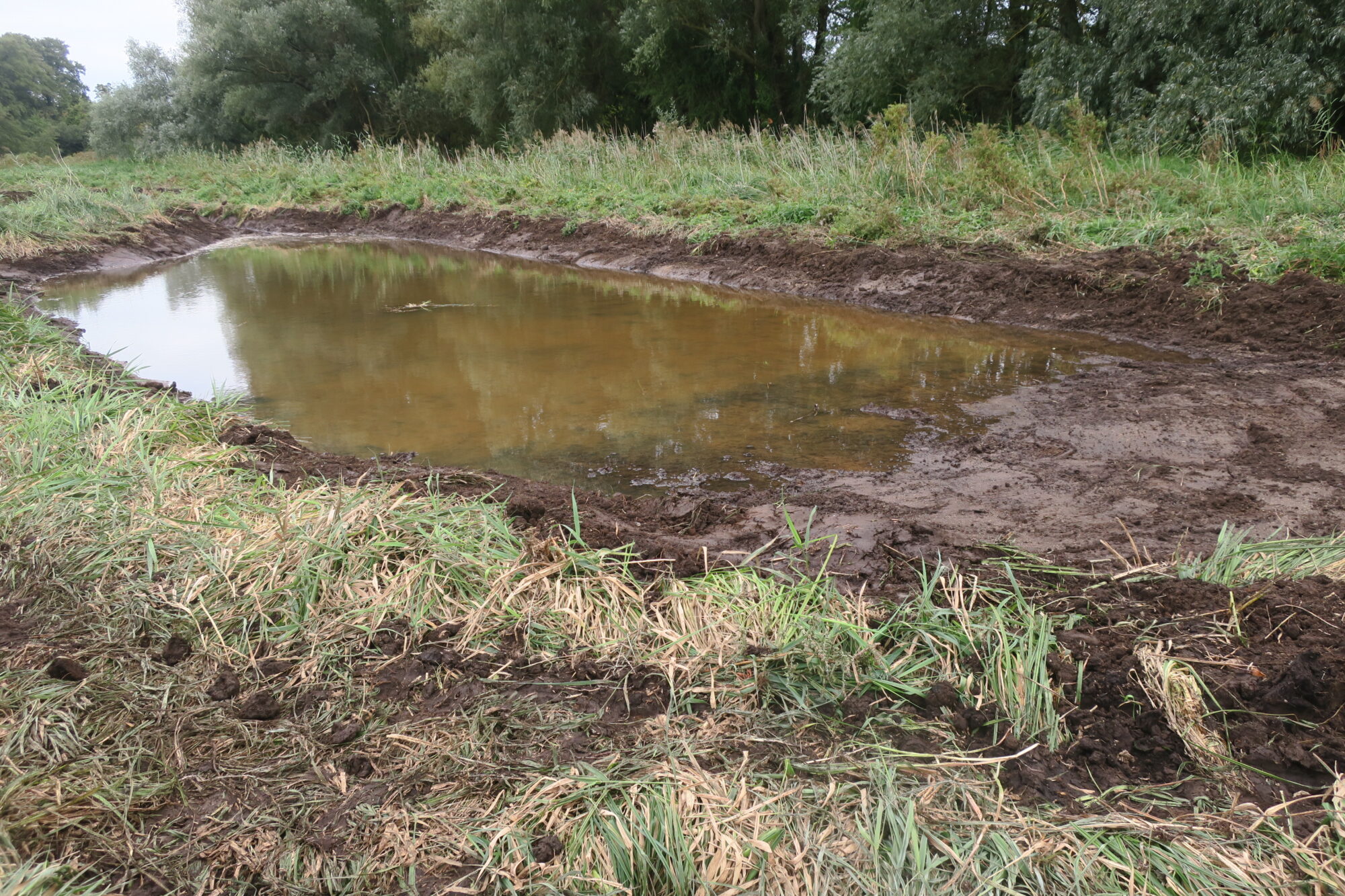
The channel enters the storage pool on the left. The other end of the storage pool is sloping to encourage a variety of flora and fauna habitat.
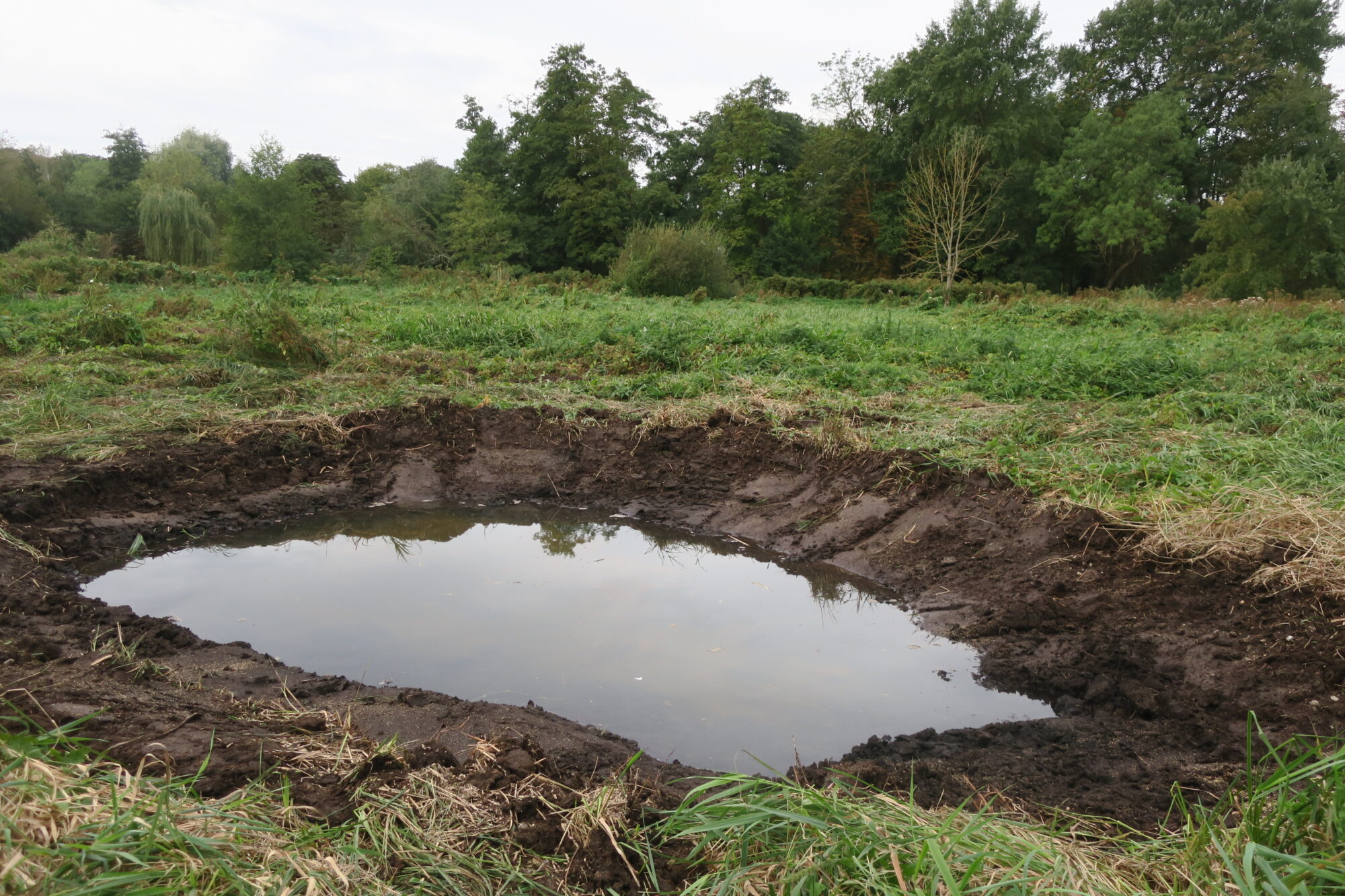
Nearby a scrape has also been created. Scrapes are shallow ponds of less than 1m depth with gently sloping sides. They hold rain or flood water seasonally and, hopefully, will remain damp for most of the year.
It all looks rather stark at the moment, but it will not be long before nature takes advantage of the opportunities offered, and all will assume a softer natural appearance.
The changes will be monitored by the Norfolk Rivers Trust to see how effective they are in reducing the drying out of the wetland. The Trust has further projects in hand to improve the effectiveness of the Yare Valley as a wildlife corridor.